4.17.2014

Expanding Our Groups: Reflections on Regarding the Pain of Others by Susan Sontag

Obviously, images of human suffering are hard to take. But Regarding the Pain of Others is worth a close read anyway. Susan Sontag, a brilliant writer, encourages readers to look, to not shy away, and to reflect. 

Through her lens we see Jacques Callot's Les Grandes Misères et Malheurs de la Guerre, Goya's Los Desastres de la Guerra, and images of the Civil War, the lynchings in the South, the Nazi death camps, the Vietnam war, and the 2001 attack on New York City. She gives us a snapshot of atrocities, staged wartime photos, and propaganda. 


Not since reading Hannah Arendt's Eichmann in Jerusalem have I been confronted with such precision and insight about atrocities humans commit against other humans, and about the "banality of evil." Sontag writes:

"To designate a hell is not, of course, to tell us anything about how to extract people from that hell, how to moderate hell’s flames. Still, it seems a good in itself to acknowledge, to have enlarged, one’s sense of how much suffering caused by human wickedness there is in the world we share with others. Someone who is perennially surprised that depravity exists, who continues to feel disillusioned (even incredulous) when confronted with evidence of what humans are capable of inflicting in the way of gruesome, hands-on cruelties upon other humans, has not reached moral or psychological adulthood."
While reading Sontag's book I made a point to search the images on the web. I found them all. And I'm still reeling. But what can I do with all these images of violence and horror? Is recognition and feeling compassion enough? Should I, as self-preservation, allow myself to become callous, indifferent to images from far away or in the past? Sontag suggests we should translate compassion into action.
"Compassion is an unstable emotion. It needs to be translated into action, or it withers. The question is what to do with the feelings that have been aroused, the knowledge that has been communicated. If one feels that there is nothing 'we' can do...then one starts to get bored, cynical, apathetic."
Indeed, cynicism and apathy are poisonous and paralyzing. While it may just be our nature as a species to form groups, to separate our own groups from individuals in other groups, to misrepresent each other and attack the misrepresentation, to define people as we see them and not as they really are, Sontag’s book reminds me that I can instead and should work to expand our definitions of groups to include all of humanity, to understand the pain of others, to recognize that people in East Africa and France and people all over the world experience much of the same things I experience, to remember that violence against my next door neighbor is just as terrible as violence against the people of Iraq, Syria, and Ukraine.

We can take action by expanding our own identified groups to include all of humanity. We can work to understand that we are part of an extremely large group of individuals who suffer, love, and experience anger and joy. Doing this work will likely reduce political disagreement and remind us to eschew acts of violence all over the world. This is why Sontag's book is important, at least for me.


This book is not entertainment. Not easy reading. But it should still be read, even though violence en masse appears to be on the decline and our current conditions, for the most part, don't resemble some Hobbesian state of nature. It should be read as we contemplate ongoing conflicts around the world. It serves as a warning sign, a reminder to not repeat past errors. 

Suggestions for Further Reading


Eichmann in Jerusalem: A Report on the Banality of Evil 

By Hannah Arendt

Why Isn't There More Violence?

By John Mueller

The Better Angels of Our Nature: Why Violence Has Declined

By Steven Pinker

Joint Geneva Statement on Ukraine from April 17: The Full Text


3.23.2014

Five Sigma at Point Two

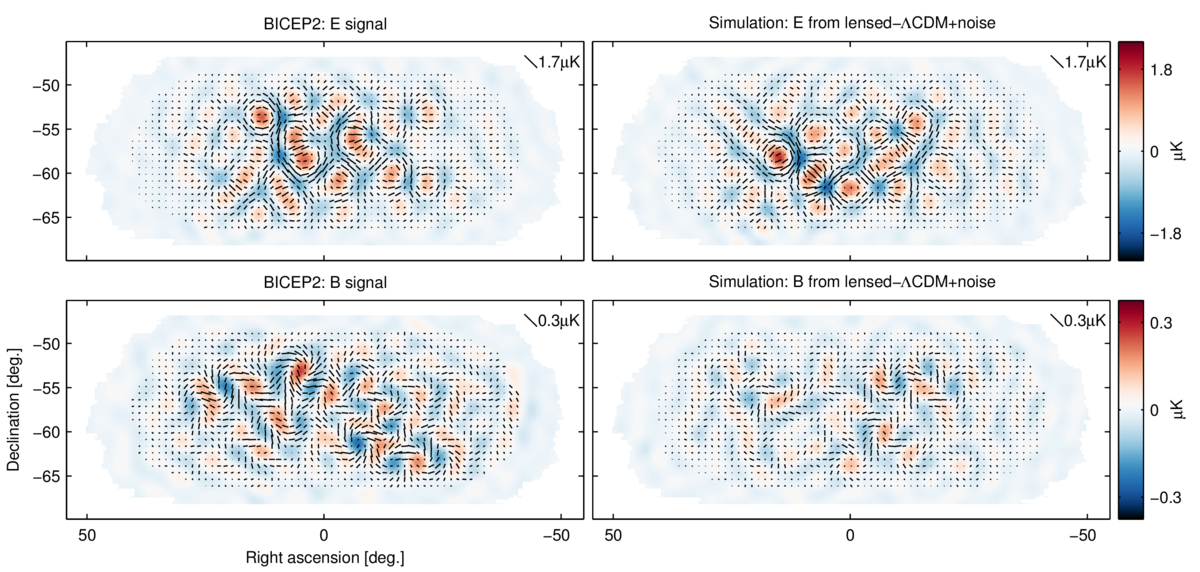
BICEP2 Apodized E-mode and B-mode Maps
Researchers, using a super powerful microwave telescope, the BICEP2 at the South Pole, detected signs of primordial gravitational waves in the polarization of the Cosmic Microwave Background Radiation, the "observable afterglow of the Big Bang." These waves appear to be direct evidence of cosmic inflation, the terrific period of expansion of the universe that happened about 10-35 seconds (that's about 0.00000000000000000000000000000000001 seconds) after the Big Bang, or as Stanford professor of physics Chao-Lin Qou calls it, the "bang in the Big Bang." This period of expansion, according to inflation theory, created uniformity in the universe in every direction. This evidence of gravitational waves suggests "a deep connection between quantum mechanics and general relativity." Inflation theory was first conceived about 30 years ago.

This is an astounding find. If the BICEP2 results can be replicated and verified by others in additional experiments, we can be assured that we are one step closer to understanding the origins of our universe. The next step could come in another 30 years. Or in 100 years. We shall see.

But there is also a deeply profound and humbling human element to this new discovery. To be able to create a telescope that can help us see these gravitational waves, to apply what we know about the physical world and develop mathematical models that try to explain things that happened billions of years ago, and to be able to validate complex theories with concerted effort and evidence are all remarkable human achievements. This discovery is cause for celebration.

The video below, though an odd Publishers Clearing House kind of moment, captures the human spirit at its best. In it, Andrei Linde, one of the founders of "inflationary universe theory," gets the news that the theory is very likely right on the money. Note how his wife, Stanford physics professor Renata Kallosh, reacts to the news, how she gives professor Quo a hug, her eyes closed during the embrace. It's as if she and Linde had just won a million bucks. Remarkable.

Then the champagne comes, and the toast, and then the wonderful smiles, and then Linde's description of inflation theory as being beautiful. Apparent are his feelings of validation and joy. They have completed a 30-year long marathon. They're excited, exhausted, and incredibly happy. Linde's reaction, his contentedness, relief, and triumph left me in tears.

"If this is true," Linde says in the video, "this is a moment of understanding of nature of such a magnitude that it just overwhelms." Indeed. I too am left with an incredible sense of awe, not just about the science, but of human progress and achievement.

Congratulations Dr. Linde and Dr. Kallosh, and all the researchers involved in the BICEP2 collaboration. Here's to you all.


For further reading and viewing:

First Direct Evidence of Cosmic Inflation
Harvard-Smithsonian Center for Astrophysics

BICEP2 2014 Results Release
http://bicepkeck.org

BICEP2 Press Conference (Video)
http://www.cfa.harvard.edu/pao/Bicep2_news_con.mp4

What is the Cosmic Microwave Background Radiation?
By Erik M. Leitch at the University of Chicago
Published in Scientific American

A Scientific Breakthrough Lets Us See to the Beginning of Time
By Lawrence Krauss
The New Yorker

First Direct Evidence of Big Bang Inflation
By Camille Carlisle
Sky & Telescope

2.22.2014

Funk & Wagnalls Will Outlive This Man


"Now when our ship had left the Ocean River rolling in her wake
and launched out into the open sea with its long swells to reach
the island of Aeaea—east where the Dawn forever young
has home and dancing-rings and the Sun his risings—
heading in we beached our craft on the sands,
the crews swung out on the low sloping shore
and there we fell asleep, awaiting Dawn's first light."
          —The Odyssey, XII, 1-9, Homer, Translation by Robert Fagles
When I was a kid, my mother bought an entire set of encyclopedias and a two-volume set of the Funk & Wagnalls New Comprehensive International Dictionary of the English Language, the Deluxe Reference Edition, from a smooth-talking door-to-door salesman. The purchase was an expression of love. These books were to launch my brother, my sister, and me on a course of learning and success. She signed up for the installment plan. Paid each month for years.

For an eight-year-old kid, the books were a blessing, particularly Funk & Wagnalls, dark red with embossed gold lettering and pages with gilded fore-edges. Each volume two inches thick, with sturdy binding. Well-constructed all around books.

Funk & Wagnalls were extremely practical. I used them every day as impervious walls for action figure battle stations, or as mountains G.I. Joe and Star Wars figures repelled. And when used as enemy forts, they’d crash down on Destro and Cobra Commander after missiles landed. The books withstood massive battles as Quick Kick, Chewbacca, Snake Eyes, Han Solo, and Gung-Ho joined forces to infiltrate a unified Storm Trooper/Cobra Viper/Cobra Trooper base and unraveled diabolical schemes.

As my play became more elaborate, more complex, and more brutal, I used red Crayola markers for blood and an X-Acto knife to create scars and bullet wounds. To compliment this advance in morbid creativity, my forts needed an upgrade. I introduced wood constructions as forts. Funk & Wagnalls stacked became my workbench. I’d put pieces of wood on them with the measured side of the wood hanging off the fore-edges. Then I’d cut away, sawdust peppering my bedroom carpet. When the forts were done, and as I set in motion military sieges, I left my old friends, Funk & Wagnalls, forgotten at the corner of my bedroom like ships at the horizon set adrift and abandoned.

When I got a bit older, and teachers assigned book reports at school, I used Funk & Wagnalls to inform my writing. And I wrote badly. I could swing a bat or catch a football just fine. And I could do well at the bench press. But in my reports, I’d use large words incorrectly. My subjects often failed to agree with my verbs. And my sentences ran on and on. It wasn’t until College that I learned how to use the words from A to PL in the first volume, and the words from PL to Z in the second.

I learned the difference between my stupidity and my ignorance, and words like duniewassal, finagle, rubbish, quorum, and irremissibility. Or somnolent, scissile, bawdy, predilection, and pudendum. I learned words simply because I liked the way they sounded and how they came to be, their etymology. The volumes carried me as I sailed against ruthless currents through Ulysses, Finnegan's Wake, and Sea Wolf. They kept me afloat as I read Schopenhauer, Nietzsche, Aristotle, and Darwin, and as I plowed through the works of Sartre, Camus, Keats, Byron, Wordsworth, Lawrence, Woolf, and Yeats. They were my stalwart vessels as I set a course to Baldwin, Ellison, MLK, Hughes, and Malcolm X. Funk & Wagnalls helped me through arduous voyages, and we sailed to places “where the Dawn forever young has home and dancing-rings and the Sun his risings.”

After college, I parted with them, like the boy who parted with his giving tree in Silverstein’s book, and moved out with my girlfriend. Said goodbye to them. And I left them at my mother and Grandparent’s house, on the living room bookshelf collecting dust, their pages rarely seeing light again.

But just a few months ago, married with an eight-year-old son, a six-year-old daughter, a dog, and a cat, and a roof of my own, my mother returned Funk & Wagnells to me, still dark red, but timeworn and weathered. I welcomed them like two old memories, sat next to them with a glass of wine and flipped through their pages, reflecting on our shared history. The edges were in disrepair, the paper aged, and the covers dusty and cracked. I still want my kids to use them as I did, I thought. To discover them. But Funk & Wagnells were obsolete. Relics. Things were different.

Funk & Wagnells now sit at the top of my bookshelf like ships in a bottle, preserved. And soon, I will set out to sea again with them for one last trip, take them out through uncharted waters, to rediscover the written world. But unlike Odysseus's ship, these books will outlast me. Each flawed edge, slightly torn page, and area of faded gilding will tell my story.

2.09.2014

One Way to Help Stop Violence Against Women

"We know one in five girl children are sexually assaulted."
               – Jessica Valenti, Choosing Comfort Over Truth
Woody Allen is in the news again. And with allegations of sexual assault, it's difficult to know the truth. Perpetrators lie. Rumors spread. TMZ articles get published. So as an exercise in reasonableness, I try to wait for things to play out. Yet again, however, I'm uncomfortable appreciating Allen's work. Sexual assault is pervasive, ugly, and unforgivable. And all too common. To separate the art from the man is an approach I've taken in the past. Having to do this with regularity though is tiresome. But this is not just about Allen. This is about 1 in 5. And the men who make that 1 in 5 a reality.

Jessica Valenti's article about Allen was a shot of bourbon at 7 o'clock in the morning. Too much too early. "We know one in five girl children are sexually assaulted." That line burned. Made my blood boil. I was at the San Diego Convention Center when I read it. I walked in the exhibit hall thinking I had too much to read that morning. Kept thinking, how many women in the hall were assaulted when they were young? How many mothers, daughters, sisters, aunts, cousins, grandmothers, school teachers, principals, directors, leaders have been hurt by men? How many men in the hall were monsters? And how many of these monsters will have received my hello, smile, or handshake during the course of the day?

But to proceed in this way, to continue this line of thinking and questioning, was paralyzing. To make it through the day, three things had to happen: 1) I had to be a better man, 2) I had to assume that people were good and decent in order to be a better man, and 3) I had to sacrifice for people, "over and over, in myriad petty little unsexy ways."

For Example

On my way out of the exhibit hall, I found myself walking behind a young woman, mid-twenties, wearing a knee brace and hauling a large black fiberglass case full of heavy materials. The case was nearly as big as she was, about 4 and a half feet tall, and likely heavier than she was. Her Sisyphean bolder. She struggled, sighing and lunging with each step. And her limp was pronounced, awkward. She was clearly uncomfortable. Her entire body dipped with each effort forward, knees nearly buckling.

As she walked out the large exhibit hall doors to get to the lobby, a tall man in a tan jacket held the large door open. He clowned a smile and went on his way after she passed through. He let the door swing back to close. I rushed over and I caught the door, met up with her in the lobby.

"Let me help you," I said.

“It’s okay,” she said, a bit relieved at first and then a bit reticent. “I got it.”

"I could use the workout," I said. "It’s no problem."

She accepted my help reluctantly. A stranger, I made her uncomfortable. And rightly. Who the hell was I? And what did I want? "We know one in five girl children are sexually assaulted." By men mostly. But she was exhausted. And in pain. Vulnerable.

I made small talk to reassure her that I was harmless, that I was a man trying to be better. As I lugged that case to the elevator, I told her about my recent knee injury, to reassure her that I'd been injured too and vulnerable. That I'd been there. She wasn't alone.

As we walked down the enormous Convention Center lobby on the first floor, from the exhibit hall to the shipping center, I carried my own materials too, like a mule. But it was a weight I needed to bare.

My forehead perspired near the end of our trek. Not now, I thought. Not now. My sweat will make her uncomfortable. It'd gross her out. So I snuck in a quick swipe of my forehead with my sweater sleeve betting she'd not see. And I had to take a deep breath when we reached the shipping center, and let out a grunt, a guttural bray like that galling guy at the gym finishing a set of powerlifting. My body betrayed me.

We were cordial as I left her case at the counter. The shipping attendant took the case and sent it off for delivery. I didn’t ask where. I never asked for her name. And she didn’t ask for my name.

I wished the young woman good luck. She wished me the same. And after we said our goodbyes, I left quickly, never looking back. It seemed appropriate. She had her guard up. And I wanted to make clear to her that I wanted to be a better man and wanted nothing in return. No confirmation on a job well done. No further assistance. I didn’t want to make her nervous. And she was right to have her guard up. "We know one in five girl children are sexually assaulted."

Some Daunting Statistics

According to the World Health Organization, 35% of women worldwide have experienced either intimate partner violence or non-partner sexual violence in their lifetime.

According to The Centers for Disease Control and Prevention’s National Intimate Partner and Sexual Violence Survey (NISVS), nearly 1 in 5 women (18%) in the United States have been raped in their lifetime; 1 in 4 women have been the victim of severe physical violence by an intimate partner; and 1 in 6 women (16%) have been stalked during their lifetime.

This is an enormous problem.

And I don’t blame movies for this horror. I don’t blame magazines. I don’t blame video games. I don’t blame advertisements, guns, football, beauty pageants, the adult entertainment industry, bikinis, poverty, implants, spaghetti straps, short shorts, the education system, religion, biology, capitalism, or governments. And I certainly don't blame women. I blame us guys. I blame even us guys who think we are decent guys. Even me. We need to change the way we think. The way we act. The way we conduct ourselves in our public and private lives. On the web and at school. On the field. On the court. In the gym. In the office. In the bar. And in the bedroom.

Stopping Violence Against Women

Sure, we have complex brains full of greatness. And there's much of it we don’t understand. But there is a lot of junk in there. So guys, if a harmful impulse presents itself, bury it. If you have a condition, get help. If you’re not sure what you think or do is harmful, think harder. Think more. Even if it's just a smidgen of harm. Handle that. Then, and this is the most important thing, get out into the world and practice being decent.

It may require effort for some of you. Some Sacrifice. But you can do it. Train your brain to recognize opportunity and go out of your way to do this. Practice being decent. Dedicate time for this. Just as you do when you learn a new skill, a new sport or new computer code. Be kind. Be helpful. Courteous. Reprogram yourself. Just as you did when you learned to play the piano or to sink a jump shot or to build a swing set for your kids. Practice. Do this with regularity. Practice. You can do this. If you get tired, push yourself to do one last extra set of kindness. It's muscle memory. Practice.

I submit that if we express kindness and feel empathy toward men, women, and children, every day and work hard at it, we will become so good at it, we will begin to bring this 1 in 5 number down to 0.

I know this is possible because we all experience terrible thoughts every day and do nothing. Pulling off the highway at 65 MPH. Or punching someone in the face. Yelling at your children. But we can bury it. For self preservation. To follow the rule of law. So extend that ability to control yourself. Even if you're angry, stressed, or tired. Or if you’ve been wronged or are out of luck or tasted bigotry and discrimination. Or the fist of a father.

Preserve humanity. Start doing kind things for people simply because they are people. Make small sacrifices to be kind. Hold the door for a guy twice your size, even if you’re carrying your own stuff or having a deep conversation with a friend. Don't fret if your son wants to play with a girl's doll. Offer help and your support to everyone, but to children and women especially.

Take the shopping cart all the way back to the cart rack near the store entrance. Don’t leave it near the car parked next to you. Take a little break from your day-to-day self interests. Be patient. Help a person out. Take a moment out of your busy schedule, or your angry disposition, and congratulate someone. Compliment them. Find the good.

And don’t expect a status boost for these acts. Don’t take one if offered. And when you get home, remind the people you care about. Remind them that there is good in you and in the world. And that you're helping out.

So guys, when faced with an opportunity to be a dick, after a night out drinking with your girlfriend, and she's had too much to drink, you'll be poised instead to do the right thing. To be decent. You've had practice. You've done your reps. Help her to bed. Cover her up with a warm blanket and tuck her in. Let her sleep. And enjoy coffee and eggs with her in the morning.

The reward is 0 in 5. And future generations of guys will know better. Your sons will know better. They'll have watched you practice and will practice themselves.

Guys, 5 in 5 of us need to change.

1.20.2014

MLK's 'Letter From Birmingham Jail'

In college, I’d often read in the university library at night. Spent hours there. I used to pack a novel and a small snack. But schoolwork mostly. It was in this library I first read Dr. Martin Luther King’s “Letter From Birmingham Jail,” written on April 16, 1963, a response to a public statement of caution issued by eight religious leaders of the South. King was 34 when he wrote it. I was 18 when I read it. The power of this letter, King's patience and reasoning, left a mark, like a tattoo on my consciousness.

What follows here are the lines from the letter that still serve as reminders for me now. I sometimes fail, but I work daily to honor King in my actions. So I need these lines. And I will take them to my grave.

“I want to try to answer your statement in what I hope will be patient and reasonable terms.”

“…at first glance it may seem rather paradoxical for us consciously to break laws. One may well ask: 'How can you advocate breaking some laws and obeying others?' The answer lies in the fact that there are two types of laws: just and unjust…. One has not only a legal but a moral responsibility to obey just laws. Conversely, one has a moral responsibility to disobey unjust laws."

“To put it in the terms of St. Thomas Aquinas: An unjust law is a human law that is not rooted in eternal law and natural law. Any law that uplifts human personality is just. Any law that degrades human personality is unjust.”

“Let us all hope that the dark clouds of racial prejudice will soon pass away and the deep fog of misunderstanding will be lifted from our fear drenched communities, and in some not too distant tomorrow the radiant stars of love and brotherhood will shine over our great nation with all their scintillating beauty.”

Source: "Letter from a Birmingham Jail [King, Jr.]" - African Studies Center - University of Pennsylvania - http://www.africa.upenn.edu/Articles_Gen/Letter_Birmingham.html.

1.18.2014

Does Your Heart Flutter?

Traveling for me is typically an edifying experience. New York City, with its diversity, historical significance, and sounds, did not disappoint.

Last Saturday, after a long day of lines and air time, I and Julie—my brilliant wife and travel guide—took in the cold New York City air, fog, wet pavement, horns, and the enormous yellow line of taxis curbside, just outside baggage claim. We like big cities. The way they smell, the density, the rhythm, the countless avenues and streets. The neighborhoods. Downtowns. The languages understood by us or not. The countless stores and restaurants, delis, coffee shops, and museums. And the walking.

Flatiron District
We got in late, so we had time before our 8 O’clock show at The Stone only to grab a couple of appetizers and over-priced drinks at the hotel’s restaurant bar. Potted duck & foie gras with pistachios and drunken raisins. A plate of artisan cheeses. Alpha Tolman, Pawlet, and smokey blue. A vodka martini, dirty, for me. A cocktail with pear vodka, lime, bitters, and soda for Julie. We talked at length about our long taxi ride from JFK to SOHO. Our taxicab driver, driving slow, offered us a detailed tour through Brooklyn and provided insights on religious centers, the various boroughs, politics, police, and the “motherfuckers” on Wall Street. After the ride, I paid the cabdriver handsomely. We exchanged genuine smiles and shook hands. Wished each other well.

We went to The Stone to see Rudresh Mahanthappa, a New York-based alto sax player and composer. The Stone was a tiny place. An 800 square foot room at best with 25 chairs, a table at the door, and one bathroom shared by the audience and the musicians. Julie and I paid our $15 to get in and found seats. Mahanthappa walked in behind us with a bright smile and a gigantic overpacked backpack. Nothing fancy in his clothes. Modest. He stood a bit taller than me. A kind and gracious guy. Didn’t know it was him until he introduced himself to the woman at the door.

The Stone
As Mahanthappa, Dan Weiss, the drummer, and Rez Abbasi on guitar played their set, I was awed by their technical skill, creativity, and blending of sound from American funk, rock, jazz, and music from India and places I’ve not yet seen. And I was amazed at the audience. Young and old, from New York to Stockholm. People sitting on the floor. A lot of smiles. And me next to Julie with her eyes closed listening. The diversity in the sounds mirrored the diversity in the crowd. Perhaps in all of New York City. And the joy and peace I experienced that night was as close to the transcendent experience as Thoreau seemed to get to in nature. It seems my place is the city, around people and musicians. Artists. That night my Walden pond was The Stone.

After the show, we walked to Katz’s Deli on Houston Street on the lower east side. I had the knoblewurst on rye. Julie had matzo ball soup. We shared a soda. This was much more satisfying than the appetizers we shared earlier that night. As we ate, we talked about the music we heard and the path we’d take on our walk back to our hotel. I reveled at the beauty of the moment, eating simple food with music on my mind and appreciating Julie’s sophisticated presence and insight, and her gorgeous blue eyes and slightly crooked smile. We walked back to the hotel eager for Sunday’s explorations.

Central Park
On Sunday, we took the subway to Central Park and walked through it, admiring Belvedere Castle along the way, stopping at The Metropolitan Museum of Art to check out the Ancient Near Eastern, Egyptian, and Greek and Roman collections. The Cuneiform tablets, beads, amulets, gravestones, sculptures, weapons, armor. Items dating back thousands of years. Ancient languages and religions just as complex, diverse, and fascinating as they are today. Perhaps even more so than today. I was awed by the numerous civilizations and cultures that predated or existed in parallel with religions and traditions we know today (although greatly modified). Humans have an incredible imagination and sophistication.

Leaving the museum, I thought back to Mahanthappa’s set and his blending of modern American music and music from India. And how a museum like a city has a similar affect on me. But while we humans can be extremely creative, we can be brutal in war and uncaring in day-to-day life.

The Met
Just outside Central Park on Fifth Avenue on our way to see the Empire State building, I heard a guy yelling. Julie and I were at a stoplight waiting to cross. Julie was taking pictures. This guy was stalky, broad-shouldered, bearded. He had large uneven teeth. He wore what looked like a tracksuit, yellow, blue, and white. His cadence had a distinct rhythm. Aggressive. And he had an unlit cigarette.

“Let’s see if all you all rich people with your fancy clothes even cares,” he said. “Look at you taking pictures. With all your money and things.”

Grand Central Terminal
Then even louder and directed at me, ”Does your heart even fucking flutter?”

I tensed up and, keeping my hands at my side, made fists. I said nothing to the guy. Nor did I look back at him. But I listened. And stayed at the ready.

“Take a picture of me and this guy,” he said to Julie pointing at me.

“No,” Julie said as the light changed from red to green.

Anger hit me. But I calmed myself with a calculation. Better to walk away then to engage. I didn't know him. And he didn't know me. Julie and I crossed the street leaving the guy behind at the light. This man was having a bad time. And despite his belligerent, confrontational approach and abrasive language, he reminded me about the harsh reality of inequality in the city. He did me a service. Helped a random stranger understand. What struck me was he somehow knew I needed the reminder. That I was lucky to be traveling. And that birth was a lottery. I could’ve been him and him me.

Flatiron Building
As Julie and I took the long walk to the Empire State building that day we stopped at shops and diverted a bit. We saw the Chrysler Building, Radio City Music Hall, Rockefeller Center, the New York Public Library, MOMA, Grand Central Terminal, and more. I reflected on the marvels of architecture and human ingenuity. And human progress. I thought about the night before, looking out the window of our hotel room. The skyline. The lights. But I also thought about the economic disparities in a city I found myself beginning to love. The extremely rich. And the desperately poor. All hard working. All human.

And while we had nice, elegant dinners in New York City—the oysters, the wine, the money spent—and while we admired the brilliant buildings and overwhelming lights in Time Square and other wonders of the city, I found that the one place that suited me most of all was The Stone, a modest 800 square foot venue that served no drinks or food, had no signage but the small print on the tinted front door, with nothing architecturally to speak of and graffiti on the outside wall. Listening to artists do their thing. Feeling the rhythm. Tapping my foot and fingers. Having Julie by my side with her eyes closed. Being around other people, young and old. Falling in love with a place and culture. 

Yes, Mister. It does flutter.

City Scene

1.08.2014

Censoring Dianetics

In a short video making its way around the web currently, L. Ron Hubbard's great-grandson Jamie Dewolf tells a dark tale about the author of Dianetics and Scientology's founders. Nothing new is revealed really. But it got me thinking about my regrettable attempt to censor hubbard's books.

I worked a bookstore during my time in college. South Coast Plaza. a shopping mecca. Brentano's. It was a fine time for me. I worked with great people. All smarter than I was. I was exposed to the masters. I read novels, philosophy, poetry, books on science. The German greats. The Russians. The French. American writers. Greek. Italian. Irish. Mexican. Czech. I didn't mess around. I dreamed about having my own books shelved next to Tolstoy. So I'd be damned if any Harlequin romance novels or L. Ron Hubbard's books hit my shelves. There was no way in hell my store was going to expose the world to trash.

As the store's only "receiver," I was in a perfect position to make sure these books never reached the shelves. Nearly all the books in the store during my time there passed through my pompous hands. I worked the days shipments came in. And when the boxes of Harlequin novels arrived, with their red cut-out cardboard box displays included, I'd check them in, tear off the front covers, dump the rest in the trash. Then I'd send back expeditiously the front covers to the publisher to receive credit for the return. I'd do the same with Dianetics. Every time. In they came. Front covers off. Guts in the trash. Front covers to the publisher for credit. No one knew about this. I just made the call. I thought I was in a position to make it. I knew high art and science. And I wanted to protect the world.

Then in walked the store manager while I was tearing and dumping, minding my own business.

"What are you doing?" She said.

"Returning these books," I said. "They're crap. We shouldn’t sell this stuff."

Anger palpable. "Who the hell do you think you are?"

She then explained to me that on the one hand, we could be losing sales. On the other, and more importantly, I can't decide what a person should or shouldn't read. "Censoring Dianetics. God dammit."

Then it occurred to me. The irony. I was actually censoring books and ideas. Two things I held dear. It didn't matter that my principals were at odds with the material. I shouldn't be censoring. It was okay to engage people with differing opinions. To discuss things. But never should I bury them. If I had written a book and the "receiver" in a bookstore decided not to shelve my books near Tolstoy, I would go ballistic.

We then built those hideous cardboard displays for the romance novels, put them on the sales floor, and shelved Dianetics together. I even later sold a few of them. But I sold a lot of great books too.