Showing posts with label humanity. Show all posts

4.17.2014

Expanding Our Groups: Reflections on Regarding the Pain of Others by Susan Sontag

Obviously, images of human suffering are hard to take. But Regarding the Pain of Others is worth a close read anyway. Susan Sontag, a brilliant writer, encourages readers to look, to not shy away, and to reflect. 

Through her lens we see Jacques Callot's Les Grandes Misères et Malheurs de la Guerre, Goya's Los Desastres de la Guerra, and images of the Civil War, the lynchings in the South, the Nazi death camps, the Vietnam war, and the 2001 attack on New York City. She gives us a snapshot of atrocities, staged wartime photos, and propaganda. 


Not since reading Hannah Arendt's Eichmann in Jerusalem have I been confronted with such precision and insight about atrocities humans commit against other humans, and about the "banality of evil." Sontag writes:

"To designate a hell is not, of course, to tell us anything about how to extract people from that hell, how to moderate hell’s flames. Still, it seems a good in itself to acknowledge, to have enlarged, one’s sense of how much suffering caused by human wickedness there is in the world we share with others. Someone who is perennially surprised that depravity exists, who continues to feel disillusioned (even incredulous) when confronted with evidence of what humans are capable of inflicting in the way of gruesome, hands-on cruelties upon other humans, has not reached moral or psychological adulthood."
While reading Sontag's book I made a point to search the images on the web. I found them all. And I'm still reeling. But what can I do with all these images of violence and horror? Is recognition and feeling compassion enough? Should I, as self-preservation, allow myself to become callous, indifferent to images from far away or in the past? Sontag suggests we should translate compassion into action.
"Compassion is an unstable emotion. It needs to be translated into action, or it withers. The question is what to do with the feelings that have been aroused, the knowledge that has been communicated. If one feels that there is nothing 'we' can do...then one starts to get bored, cynical, apathetic."
Indeed, cynicism and apathy are poisonous and paralyzing. While it may just be our nature as a species to form groups, to separate our own groups from individuals in other groups, to misrepresent each other and attack the misrepresentation, to define people as we see them and not as they really are, Sontag’s book reminds me that I can instead and should work to expand our definitions of groups to include all of humanity, to understand the pain of others, to recognize that people in East Africa and France and people all over the world experience much of the same things I experience, to remember that violence against my next door neighbor is just as terrible as violence against the people of Iraq, Syria, and Ukraine.

We can take action by expanding our own identified groups to include all of humanity. We can work to understand that we are part of an extremely large group of individuals who suffer, love, and experience anger and joy. Doing this work will likely reduce political disagreement and remind us to eschew acts of violence all over the world. This is why Sontag's book is important, at least for me.


This book is not entertainment. Not easy reading. But it should still be read, even though violence en masse appears to be on the decline and our current conditions, for the most part, don't resemble some Hobbesian state of nature. It should be read as we contemplate ongoing conflicts around the world. It serves as a warning sign, a reminder to not repeat past errors. 

Suggestions for Further Reading


Eichmann in Jerusalem: A Report on the Banality of Evil 

By Hannah Arendt

Why Isn't There More Violence?

By John Mueller

The Better Angels of Our Nature: Why Violence Has Declined

By Steven Pinker

Joint Geneva Statement on Ukraine from April 17: The Full Text


3.23.2014

Five Sigma at Point Two

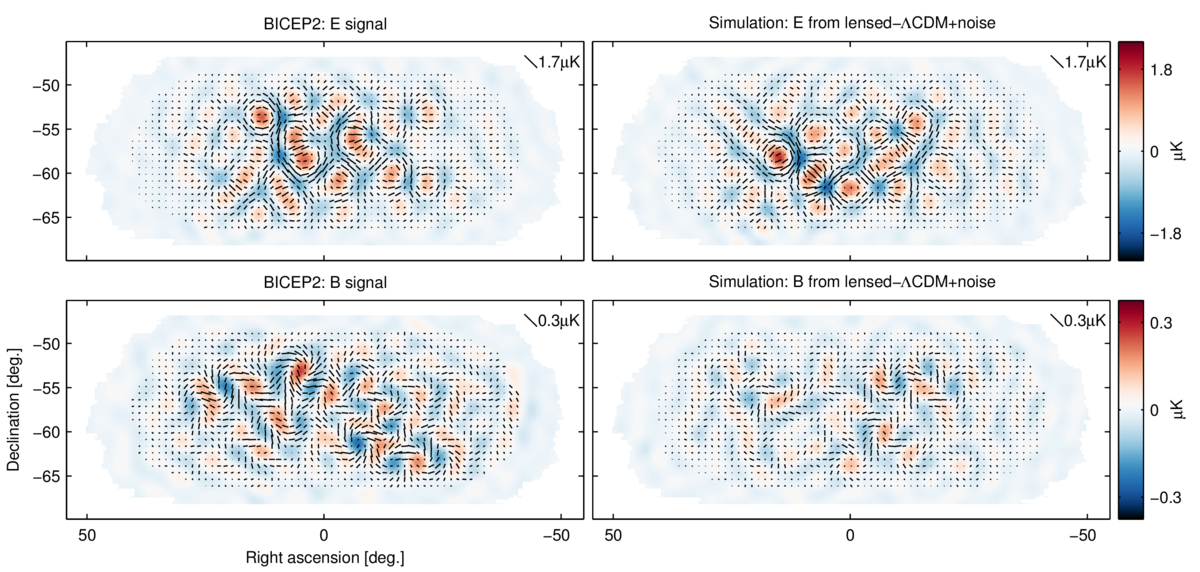
BICEP2 Apodized E-mode and B-mode Maps
Researchers, using a super powerful microwave telescope, the BICEP2 at the South Pole, detected signs of primordial gravitational waves in the polarization of the Cosmic Microwave Background Radiation, the "observable afterglow of the Big Bang." These waves appear to be direct evidence of cosmic inflation, the terrific period of expansion of the universe that happened about 10-35 seconds (that's about 0.00000000000000000000000000000000001 seconds) after the Big Bang, or as Stanford professor of physics Chao-Lin Qou calls it, the "bang in the Big Bang." This period of expansion, according to inflation theory, created uniformity in the universe in every direction. This evidence of gravitational waves suggests "a deep connection between quantum mechanics and general relativity." Inflation theory was first conceived about 30 years ago.

This is an astounding find. If the BICEP2 results can be replicated and verified by others in additional experiments, we can be assured that we are one step closer to understanding the origins of our universe. The next step could come in another 30 years. Or in 100 years. We shall see.

But there is also a deeply profound and humbling human element to this new discovery. To be able to create a telescope that can help us see these gravitational waves, to apply what we know about the physical world and develop mathematical models that try to explain things that happened billions of years ago, and to be able to validate complex theories with concerted effort and evidence are all remarkable human achievements. This discovery is cause for celebration.

The video below, though an odd Publishers Clearing House kind of moment, captures the human spirit at its best. In it, Andrei Linde, one of the founders of "inflationary universe theory," gets the news that the theory is very likely right on the money. Note how his wife, Stanford physics professor Renata Kallosh, reacts to the news, how she gives professor Quo a hug, her eyes closed during the embrace. It's as if she and Linde had just won a million bucks. Remarkable.

Then the champagne comes, and the toast, and then the wonderful smiles, and then Linde's description of inflation theory as being beautiful. Apparent are his feelings of validation and joy. They have completed a 30-year long marathon. They're excited, exhausted, and incredibly happy. Linde's reaction, his contentedness, relief, and triumph left me in tears.

"If this is true," Linde says in the video, "this is a moment of understanding of nature of such a magnitude that it just overwhelms." Indeed. I too am left with an incredible sense of awe, not just about the science, but of human progress and achievement.

Congratulations Dr. Linde and Dr. Kallosh, and all the researchers involved in the BICEP2 collaboration. Here's to you all.


For further reading and viewing:

First Direct Evidence of Cosmic Inflation
Harvard-Smithsonian Center for Astrophysics

BICEP2 2014 Results Release
http://bicepkeck.org

BICEP2 Press Conference (Video)
http://www.cfa.harvard.edu/pao/Bicep2_news_con.mp4

What is the Cosmic Microwave Background Radiation?
By Erik M. Leitch at the University of Chicago
Published in Scientific American

A Scientific Breakthrough Lets Us See to the Beginning of Time
By Lawrence Krauss
The New Yorker

First Direct Evidence of Big Bang Inflation
By Camille Carlisle
Sky & Telescope

1.07.2014

“Pick It Light, Pick It Soft”

It’s not often an entire album leaves a mark, reorganizes the brain, and truly opens the mind. The kind of music in aggregate that makes even my toes remember the first time it played over a set of boom box speakers.

Long ago, working in a now disbanded music store, I discovered such an album. At the time, I was obsessed with Jimi Hendrix, Bob Dylan, and others. Then this guy with long, wavy black hair, a mustache, and hopeful brown eyes walked in. He looked a bit like Carlos Santana. He said he was working a bar in a cover band. He played contemporary songs and some “classics.” But he heard a song the day before. He didn’t know the name. Just the melody and a bit of lyric.

“How does it go?” I said.

“Pick it light, pick it soft,” he said. “Pick it light..... pick it soft.”

I ran “pick it light, pick it soft” in my head over and over again. Santana stood at the counter for a bit racking his brain. “No clue,” I said. “No clue.” The guy left.

It had a nice sound this “pick it light, pick it soft” as he sang it. So I ask my co-worker Tribe Called Quest. And like any true music aficionado, he knew exactly what the song was.

He went, “picket lines and picket signs, don't punish me with brutality.... it's marvin gaye." Then he walked away with what seemed like a nice groove in his head.

Naturally, I picked up the album and took it home that night. I listened to it over and over and over again. The seamless transitions between songs. The tone. The textured instrumentals and vocals. The unity of the album. The mood. The beauty. I was floored. I slept well that night and awoke a new man.

Today, the album sticks with me because it opened my mind to the world. To all the pain, misery, and injustice in it. And I learned what a well-made album is. Each time I listen to it now, I’m inevitably encouraged, inspired to work toward making change. Not only in my life. But in the lives of others. The album allows the world into my now opened mind. It reminds me that there are other people in this world who experience the same pain, love, joy, anger, and everything else, as I do. And that people come from different places. Harlem. Los Angeles. Mobile, Alabama. Hà Nội, Vietnam. And everywhere else. I realized that night long ago that I was part of a larger world. But I was 17 and told no one.

So here’s to Marvin now. I owe a lot to him.